







SRP Transmission Line Design, Construction and Maintenance
Start or access your projects
Manage your construction projects through the SRP Project Plan Portal. All projects requiring SRP Transmission Line Design services must be submitted, reviewed and managed through the portal. Learn more about using the SRP Project Plan Portal on the construction services homepage.
Start a new project
Access existing projects
Federally funded projects
If your project includes government funding, the details regarding the funding must be provided in this questionnaire and submitted to SRP.
To see a list of current projects, visit the grid management and improvement projects page.
Construction process for transmission projects
Initiation
Submit plans in the
Include:
- An initial set of project plans
- A completed SRP Checklist and Request for Engineering Design form
Predesign
An SRP representative will work with you to gather all the required information about your project. A scoping meeting will be scheduled with SRP Transmission to review your plans, discuss responsibilities on the SRP Checklist and Request for Engineering Design and develop a timeline.
Transmission Design will then provide an estimate with a design agreement and invoice. You must execute the design agreement and pay 10% of the total estimate as a design fee prior to proceeding with design.
Design
Once your documents are reviewed, a design plan will be made for your project. Key milestones during this phase include:
- Assignment to an Engineering Resource either internal or to an external consultant
- Customer will need to provide Final Civil Site Elevations with SRP to verify
- Customer will need to provide 100% Final Sealed Plans
- Customer will need to provide TLD with new or replacement easements
- Customer will need to provide TLD with a signed Construction Agreement and pay a final invoice
Please read the Customer Milestones Checklist for a full list of important steps and details.
SRP Construction
- SRP Construction is scheduled once the following are completed:
- 100% site grading for future pole locations is complete.
- Easements are executed.
- All payments and signed agreements are received.
- TLD will schedule a Preconstruction Meeting with SRP Construction.
- TLD PM to invite T-Line Construction Consultant and Engineering Resource.
- Customer to invite project stakeholders.
- Preferred in person and on site.
- TLD will work with SRP Construction and SRP Field Operations. Potholes will be completed if necessary.
- TLD will notify Customer of unexpected conflicts that arise during construction.
- SRP Construction is complete when new alignment is energized.
- SRP Construction is scheduled once the following are completed:
Specifications and guidelines
SRP Checklist and Request for Engineering Design
The SRP Checklist and Request for Engineering Design is the first document where Transmission is able to review high-level scoping requirements of your project.
Customer Milestones Checklist
The Customer Milestones Checklist expands on the process that TLD will go through during the project. Milestones include items needed from you (Customer) and items you can expect from us (SRP).
Customer relocation exhibit
Information about potential needs to obtain third-party easements from neighboring parcels.
SRP Technical Provisions
General information to consider when planning or performing construction activities near SRP’s power and water facilities.
Frequently asked questions
Find answers to some of the most frequently asked questions about construction services.
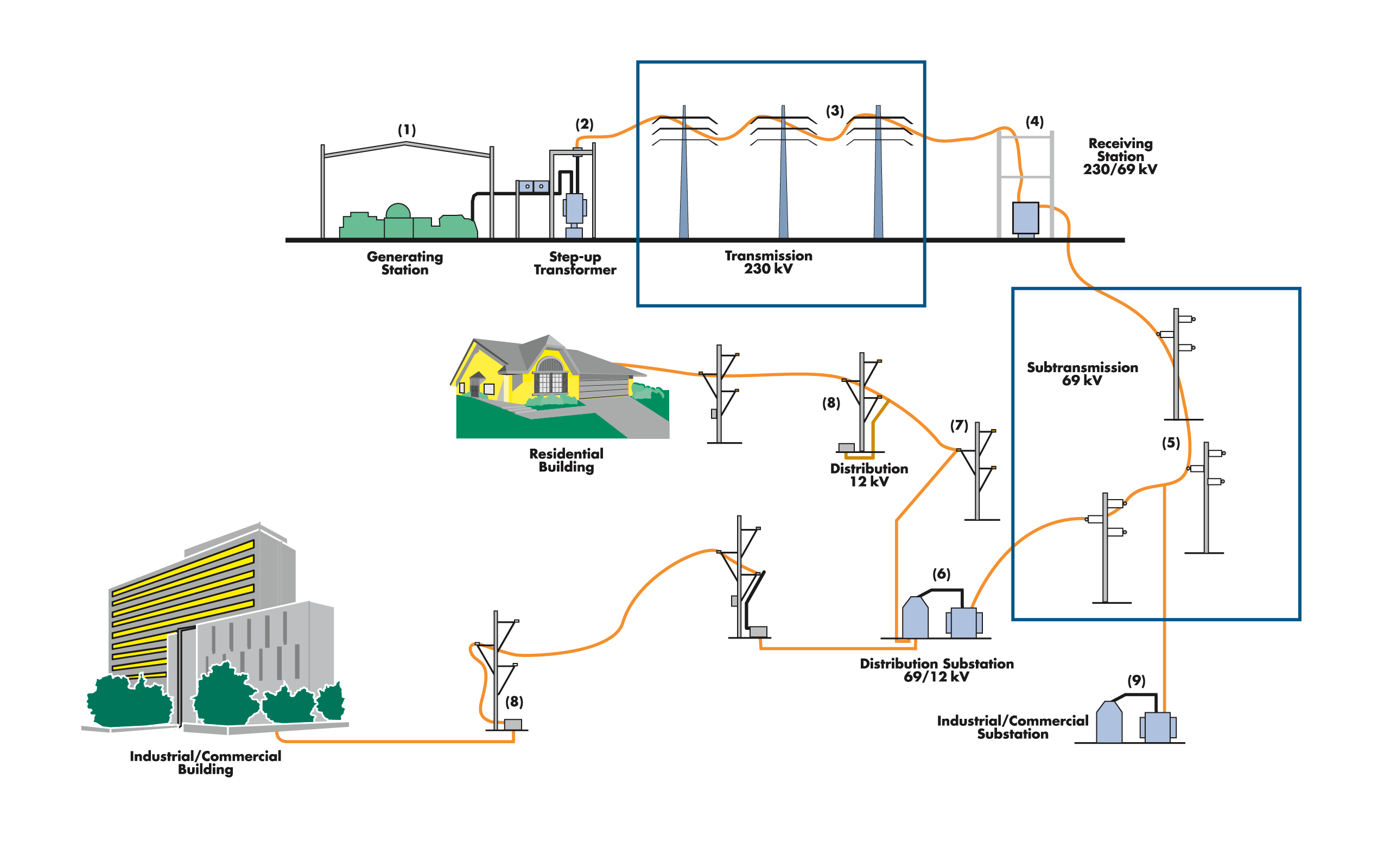
The SRP transmission system brings power from electrical generation sites (No. 3 and No. 5) through receiving stations (No. 4) and either feeds distribution substations (No. 6) or industrial/commercial customers (No. 9).
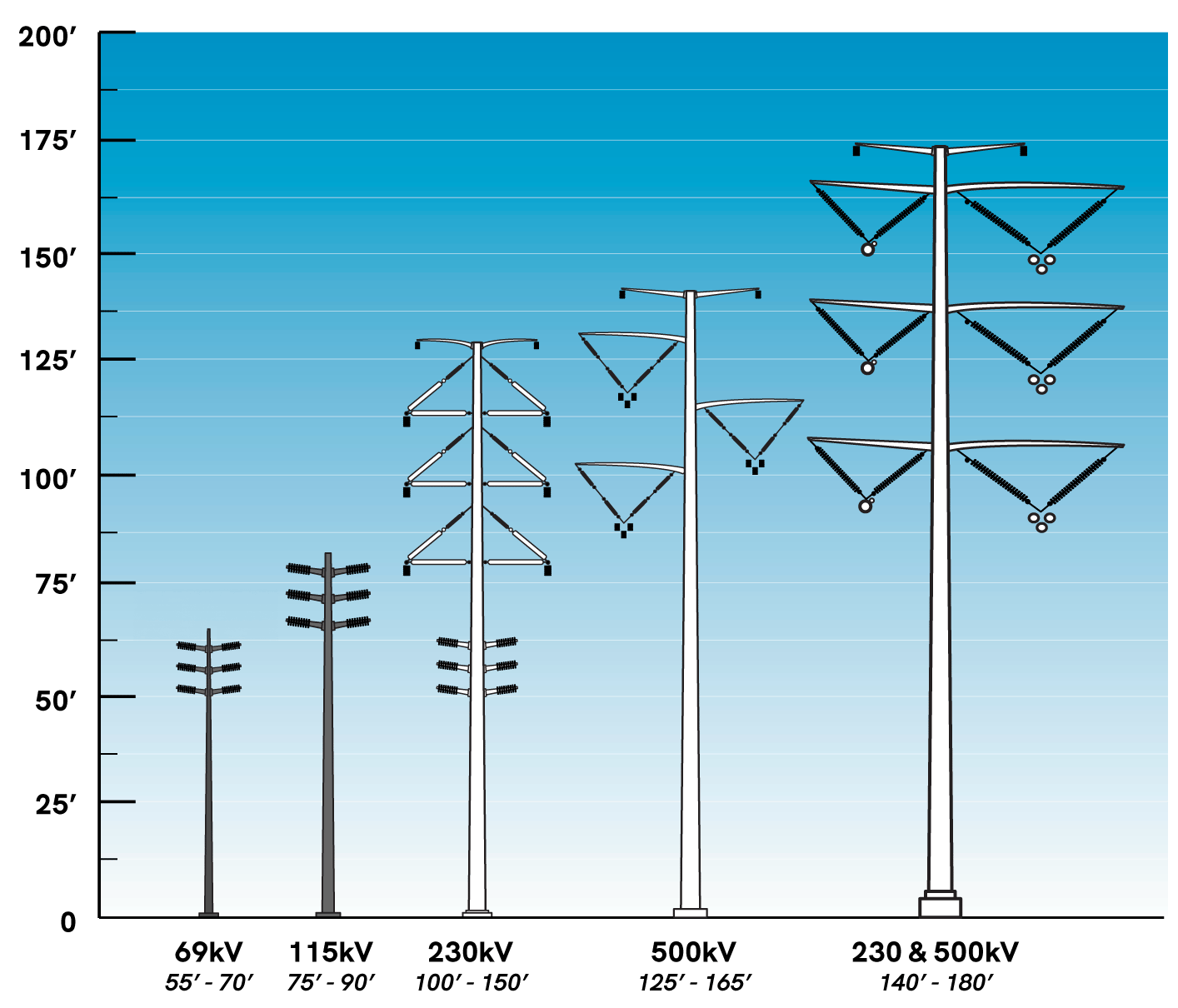
SRP's transmission system consists of a variety of poles and towers depending on the voltage. The image shows a typical height difference between the transmission poles based on voltages in the SRP system. Transmission towers vary in design, but their structure heights remain relatively steady throughout the system. Transmission towers are typically found in alignments with voltages above 69kV.
SRP's 69-kilovolt (kV) transmission power line network serves as the backbone of SRP's neighborhood electrical system. These power lines interconnect local substations, providing system redundancy and reliability. The 69kV transmission lines bring power to substations to meet the area's growing demand for power and provide better electric reliability to the community.
New transmission lines are often needed to accommodate future energy demands in the growing Valley community. Upgrades to the existing system will reduce the probability of outages, while providing higher electric reliability to the surrounding customers. New lines are often part of a larger effort to upgrade SRP systems and infrastructure, so we can continue to meet the energy demands of our customers and provide reliable power.
Typically, it is new development in the area that will increase overall load on the system. SRP strives to increase the capacity of the system early to get ahead of potential growth and reduce the risks of outages in the future. These additions will increase overall reliability and decrease overall outage response time.
SRP's standard construction practice for 69kV lines is overhead, which allows for easier maintenance of the lines and reduced construction costs for our customers.
Installing a 69kV power line underground costs about 10 times the cost of overhead construction. Future costs for underground 69kV projects are difficult to predict because of the rapidly rising costs of oil and copper, two key components of the underground wire. Our 69kV lines traverse neighborhoods across the Valley; burying all of them would be very costly and affect our customers' electric prices substantially.
Developers often bury existing 12kV distribution lines and build the new electrical infrastructure underground. Those costs are paid for by the developers. In the very few cases where SRP has located high-voltage transmission circuits underground, the cost differential was funded by a third party for safety reasons, like the proximity of a line to an airport.
SRP engineers consider a variety of factors in making our final route selection: the ability to obtain land rights/easements; construction feasibility; maintainability; cost; public impact; environmental concerns; and existing development in the area.
A substation is a facility that converts a higher voltage of electricity to a lower voltage (or vice versa) by use of one or more power transformers. Similar to a switchyard, a substation also monitors and protects each circuit (including distribution circuits) and provides operational control to ensure the system is safe, reliable and maintainable.
The costs of future projects are included in our rate base, which is re-evaluated each time SRP goes through a price process. The cost of any one transmission line addition will not have a significant impact on rates.
SRP is a community-based, not-for-profit organization. We make decisions in the best interests of our customers and the communities we serve. We do not have shareholders or pay dividends. Revenues generated through the sale of electricity are reinvested in the company to help keep SRP prices among the lowest in the Southwest.
Transmission line audible noise is characterized by crackling low-frequency tones, which are best described as humming sounds. Multiple high-voltage transmission lines currently exist throughout the Valley. The level of noise, if noticeable at all, can vary depending on precise location, voltage of the line, load on the line and other environmental factors.
New lines are first designed, then SRP will identify the specific and necessary easements for the project. Based on final design, there may be some easements necessary on private properties. New 69kV transmission lines require an easement width of 40 feet. Larger voltages require wider easements.
There are many variables to consider in the valuation process. Each property is different; an appraiser would have to consider the criteria of the property (e.g., size, zoning, location, proximity to major arterial streets, etc.). In the valuation process, the appraiser would also consider current market conditions of the area and its unique amenities (e.g., quality of schools, available retail shopping, restaurants, parks, other recreational amenities, ease of access via freeways and local streets, etc.).
Generally, transmission lines would not be considered as a material factor in the determination of property values. Given the number of variables to evaluate in the appraisal process, it would be premature and likely inaccurate to give any specific response regarding the value of any specific property without an appraisal.
There are no conclusive studies that show a link between electromagnetic fields (EMFs) and health impacts.
The major research on health effects of low-frequency (60-hertz) EMF has been performed in the following areas:
- Epidemiological studies attempt to establish patterns, links or association between environmental agents and diseases in human populations, such as cancer or leukemia.
- Animal studies have been performed on animals over several generations at exposures that are thousands of times higher than the EMF in a typical residential setting.
- Biological studies look for EMF responses on individual cells or DNA.
- Clinical studies have been performed on human volunteers in residential or work environments.
The overall scientific consensus about EMFs with respect to health is summarized by the information currently posted on the World Health Organization's (WHO) website. 'Based on a recent in-depth review of the scientific literature, the WHO concluded that current evidence does not confirm the existence of any health consequences from exposure to low level electromagnetic fields.'
Several thousand scientific papers have been published and over two dozen expert panels have reviewed this research. For most diseases, the epidemiology has been inconclusive and inconsistent, although some childhood leukemia studies have found an increased risk with magnetic field exposures. Epidemiological studies do not provide a conclusive cause and effect between EMF exposure and disease, and the animal, biological and clinical studies that have been done do not support a hypothesis that EMFs are harmful. Additionally, no plausible bio-mechanism is known by which 60-hertz magnetic fields would be harmful.
Yes, please refer to the following links:
SRP strives to keep our community informed of upcoming projects Valleywide. The public outreach process is comprised of meeting with public officials representing the region, jurisdictional agencies, and key landowners and stakeholders to inform them about the project. Additionally, SRP mails postcards to customers and landowners in the general project area to inform them of the new facilities to be constructed. A website is also created where anyone may obtain additional information about the project and view project updates. The website address is included on the postcard. A member of SRP's Project Team will respond to all inquiries received from the public.
RELATED TOPICS
Easements, leasing and licensing SRP-owned land
Find out the difference between easements, transmission encroachments and leasing or licensing SRP-owned land.
Commercial Specifications Guidelines and Handbooks | SRP
SRP is here to support you. Here, you’ll find all commercial specifications guidelines and handbooks available for download.
SRP New Construction Solutions Program | SRP
Learn about the SRP New Construction Solutions Program designed to help project teams create sustainable buildings and save on costs with rebates.


