






How SRP ensures your power quality
Protect your electrical equipment with SRP Power Quality Services
Power quality voltage sag, harmonics, voltage transients and flicker can all cause damage to your electrical equipment. Our services, which include diagnostics, monitoring and prevention strategies, can help you find and resolve the cause of power quality problems.
What causes power quality issues?
A number of factors can cause power quality issues, including lightning strikes, a short circuit in your home wiring, or a power system event. Poor grounding and improper wiring can also contribute to home or commercial building power quality problems.
Common Power Quality Terms
This list of terms and definitions outlines the different types of power quality disturbances you may experience.
Harmonic Voltage Distortion
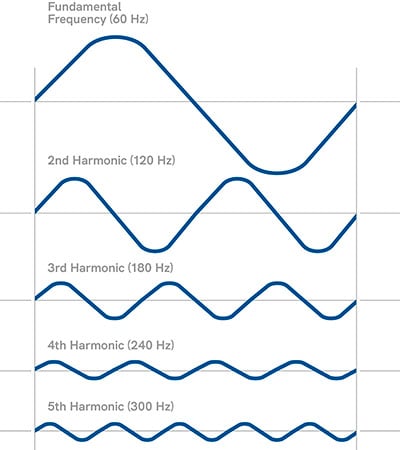
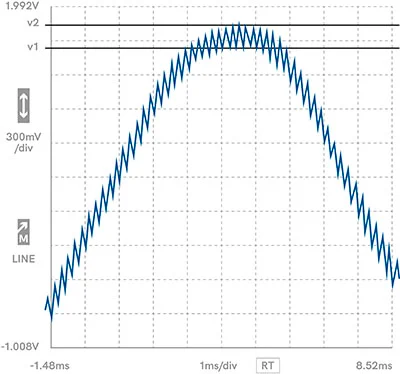
Voltage distortion occurs when harmonic frequencies are added to the 60 hertz (Hz) voltage or current waveform, making the usually smooth wave appear jagged or distorted. Distortion can be caused by solid state devices such as rectifiers, adjustable speed controls, fluorescent lights and even computers.
At high levels, distortion can cause computers to malfunction and cause motors, transformers and wires to heat up excessively. Distortion is probably the most complicated and least understood of all power disturbances.
Flicker
Flicker can be defined as small amplitude changes in voltage levels occurring at frequencies less than 25 Hz. Flicker is caused by large, rapidly fluctuating loads such as arc furnaces and electric welders.
LED lightbulbs can be the cause of light flickering. Depending on the situation, there are many factors on why LED bulbs flicker. Flicker is rarely harmful to electronic equipment but is more of a nuisance because it causes noticeable changes in lighting levels.
Voltage Interruptions
Voltage interruptions occur when voltage levels drop to zero. Interruptions are classified as momentary, temporary or long-term. Momentary interruptions occur when service is interrupted but automatically restored in less than two seconds.
Temporary interruptions occur when service is interrupted for more than two seconds but is automatically restored in less than two minutes. Long-term interruptions last longer than two minutes and may require field work to restore service.
In some cases, momentary outages may go unnoticed or cause no apparent problems. However, even momentary outages can last long enough to shut down computers and disrupt the operation of sensitive electrical equipment.
Noise
Noise, or more specifically electrical noise, is a rapid succession of transients tracking up and down along the voltage waveform. The magnitude of these rapid transients is usually much less than that of an isolated transient.
Noise often originates in electrical motors and motor control devices, electric arc furnaces, electric welders, relays and remote atmospheric discharges, such as lightning.
Although less destructive than a large rapid transient, electrical noise can cause computers to malfunction and can interfere with the operation of communications equipment or other sensitive electronic equipment.
Transients
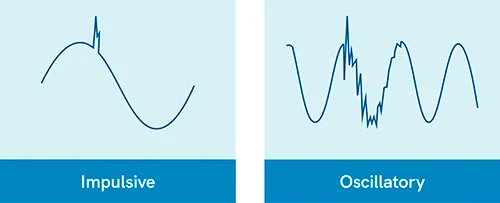
Transients are sudden but significant deviations from normal voltage or current levels. Transients typically last from 200 millionths of a second to half a second. There are two types of transients,: impulsive (lightning, electrostatic discharge, arcing, etc.) and oscillatory (load switching, capacitor switching, etc.)
Transients can erase or alter computer data, resulting in difficult-to-detect computational errors. In extreme cases, transients can destroy electronic circuitry and damage electrical equipment.
Voltage sags
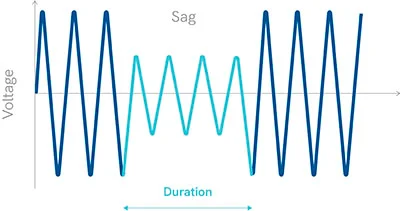
A voltage sag is a short-duration decrease in nominal voltage. Voltage sags longer than two minutes are classified as undervoltages. Common causes of voltage sags and undervoltages are short circuits (faults) on the electric power system, motor starting, customer load additions, and large load additions in the utility service area.
Electrical power system events can be unpredictable and not avoidable. It is important to protect your equipment by installing mitigation devices to your equipment.
Sags can cause computers and other sensitive equipment to malfunction or simply shut off. Undervoltage conditions can damage certain types of electrical equipment.
Voltage swells
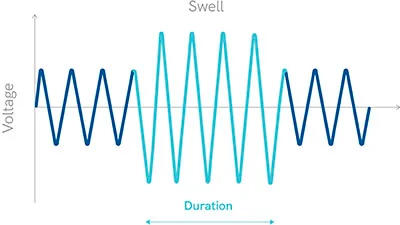
A voltage swell is a short-duration increase in nominal voltage. Voltage swells lasting longer than two minutes are classified as overvoltages. Voltage swells and overvoltages are commonly caused by large load changes and power line switching.
If swells reach too high of a peak, they can damage electrical equipment. The utility's voltage regulating equipment may not react quickly enough to prevent all swells or sags. Mitigation devices should be installed if swells affect your equipment.
Still have questions or concerns? Call (602) 236-8888 or email [email protected].


