A proud past: facts and photos
Did you ever wonder how transmission lines were constructed, or about the history
of the Apache Trail? Read on for a few short history lessons about SRP. Click on each
photo to see a larger version.
The transmission lines from Roosevelt to Phoenix and in the eastern mining area were
constructed from 1907-1927. The line ran from Roosevelt dam to the town of Mesa,
where it would meet the distribution system for the Valley. Additional lines continued
to the Gila River Indian Reservation and into the town of Chandler as well.
Construction begins
The United States Wind Engine and Pump Company,
a windmill company from Illinois, was selected to supply the towers.
A group of 35-50 men, mostly Indians, constructed the transmission line. Workers were
able to lay five miles of tower foundations a month. The Arizona Republican
estimated that 500 barrels of cement and 12 tons of anchor bolts comprised the tower foundations.
Most towers were about 35 feet tall, but heights ranged from 15 to 90 feet. The tallest were in
depressions and the shortest on mountain crests.
The assembly of the towers performed on site took 12 men. Eventually the workmen were
raising an average of seven towers per day, with 14 of them per mile.
The completed project
Once completed, the entire line stretched 65
miles from Roosevelt Dam to the Pacific Gas and Electric Company's plant in Phoenix.
When the line reached Mesa near the Highland Canal, steel poles carried the wires, instead of
towers, into the Salt River Valley. This 19-mile long branch took off from a switching station
northeast of Mesa. It consisted of two three-phase circuits.

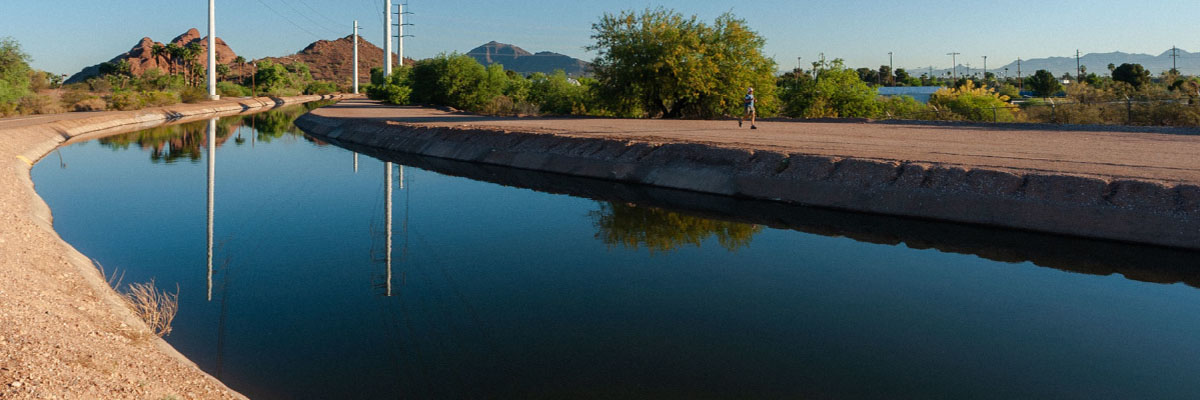
The Arizona Canal is the northernmost canal in the water distribution system of SRP.
Constructed by the Arizona Canal Company between 1883 and 1885, the Arizona Canal initially
spanned 42 miles. An additional 5 miles was added by 1894 at the far western portion of the canal.
Except for some minor relocations, the Arizona Canal follows the same alignment today as first engineered.
The Ingleside Resort brings economic growth
The development of the Ingleside Resort serves as an example of the impact the Arizona Canal had
on the economy. In order to bring investors to the Salt River Valley, William J. Murphy planned and later
built a private hotel call the Ingleside Club near the town of Scottsdale. The clubhouse was finished in
1910 and the grounds contained a golf course and asphalt tennis court. Murphy planted citrus and olive
trees on this ten-acre townsite with views of Camelback Mountain and the Papago Buttes.
Ralph Murphy, William Murphy's son, took over operation of the Ingleside property and by the early
1920s it became known as the Ingleside Inn, the Valley's first resort known as the place "Where Summer
Winters." The Ingleside Inn provided accommodations for primarily midwestern guests who wanted to
experience western living with an elegant touch.
In 1928 homesites were sold surrounding the golf course. The Ingleside Inn later was turned into the
Brownmoor School for Girls and the Arizona Country Club purchased the golf course, which is still in use today.
Effects on the Salt River Valley
The Ingleside property is representative of early Salt River Valley life with changes that occurred
because of the construction of the Arizona Canal. Initially farmed in 1886 with traditional crops, W. J.
Murphy planted orchards three years later, changing the type of harvest from a land intensive production
to a more profitable cash crop which required less acreage. The city of Scottsdale has a similar history
with extensive orchards planted by its founder Winfield Scott and the growth of first class resorts.

One of the first steps taken by the federal government during the outbreak of World War I was to
place guards over all public works, all property of public service corporations such as railroads,
telegraph lines, privately owned water systems and lighting plants in the United States.
One of the most important public works guarded was Roosevelt Dam in Arizona.
The dam is located 80 miles east of Phoenix and was one of the most important projects
undertaken by the United States Reclamation Service.
When the United States entered into World War II in 1941, Salt River Project employees,
along with millions of other Americans joined the military. A total of 186 men and one woman,
Martha Ross, executive secretary to Lin Orme, entered various branches of the service.
Like most other employers, SRP granted these employees leave and upheld their jobs until
the war ended.

The Mesa-Roosevelt Road (known as the Apache Trail) was originally an old path. This narrow,
rugged trail was converted to transport heavy equipment and supplies a distance of nearly 60
miles from the town of Mesa to the Roosevelt Dam site.
Some of the most difficult and dangerous work had to be done by hand. Almost 400 "force account"
laborers were housed in six camps along the route and worked through the spring and summer.
The Apache Indians provided much of this labor force, working long hours under brutal summertime
conditions - conditions that required treks of up to four miles for drinking water.
Completed in 1905, the Mesa-Roosevelt Road was constructed at the cost of more than $250,000.
Today the Apache Trail is a highway that connects three of SRP's dams on the Salt River: Roosevelt
Dam, Mormon Flat Dam and Horse Mesa Dam. In 1987, this 62-mile area was dedicated as Arizona's
first historic highway.

Horses have played an important role in SRP history, from hauling freight during the construction
of Roosevelt Dam to demossing laterals and irrigation ditches. SRP utilized the horse teams for
nearly 50 years to clear waterways where large equipment was unable to work.
The horses worked in pairs, single file and would cover about two and a half miles per day
pulling a seven plow disks. The disks cut the heavy moss and grasses that were then removed
by workers as the cuttings moved downstream. The average lateral that the teamster worked
was about four and a half feet deep and from two to eight feet wide. Two demossing teams
were employed during the season that usually began in late March and lasted until the end of October.
The average weight of the draft horses was about 1,500 pounds. The 12 head ate eight bales
of hay and five bounds of oats per day. Between the working seasons, the horses were
corralled at the Northside Irrigation Camp on Thomas Road.

Zanjeros have played a key role in the history of SRP's water delivery system.
The word "zanjero" is derived from the Spanish words "zanja" meaning "deep ditch
or irrigation ditch" and "zanjon" which means, "ditch rider or overseer."
A zanjero is an SRP employee whose principal responsibilities involve the manipulation of
irrigation gates for the orderly delivery of water to fill irrigation requests. In the early days,
most zanjeros traveled through their area on horseback or by horse and buggy as they provided
water service to the shareholders.
Today, as in the early days of the SRP, service to the water shareholders remains a primary duty.

During the Great Depression of the 1930s, scarcity of funds limited the amount of maintenance
of work done on the SRP irrigation system. President Franklin D. Roosevelt was committed to
programs that assisted finding work for the unemployed, so the Civilian Conservation Corps
(CCC) came to the Salt River Valley in the fall of 1935. Utilizing the services of this federal
agency, the Salt River Valley Water Users' Association had the men construct headgates, line
canals and help repair damages to irrigation structures throughout the Project.
Operation and maintenance of the SRP irrigation system was reaching a critical point in 1938.
A large number of ditch structures had been constructed of redwood lumber during the early
years of the Project and these features were wearing out when CCC crews replaced practically
all these structures with concrete.
The CCC also worked on modifying the ditch and lateral capacities due to the increase in
specialty crops, such as lettuce. The original lateral system was designed for diversified
cropping, which permitted delivery of water through a normal rotation. The specialty crops
often required simultaneous demands for water service with the same contiguous areas.
The CCC completed more than 700 projects at SRP.

In the 1920s, SRP's electric customer base expanded rapidly. In 1922, the Salt River Valley
Water Users' Association delivered its first electricity to residential customers, where
previously it had sold power only for irrigation pumping, mining and some small industries.
The move to residential service was primarily in response to shareholders in the Association --
farmers who could not get power from other providers because rural customers generally were
not profitable.
SRP began to construct lines in 1928 to supply these rural customers with electricity. At the same
time, power from the dams was also sold to copper mines in the Miami-Globe area and sold
wholesale to private utilities in the Salt River Valley.
By 1932 SRP dams generated more hydropower than all the other federal reclamation projects
combined. In 1930, when only 25% of rural America was electrified, 80% of those living in SRP
service territory received electric service.

The Crosscut power facility has been an important part of SRP's power production system.
From 1912 to 1914, the Crosscut hydro generating plant was built as a source of auxiliary
power. Its construction added nearly 40% to the Project's generating capacity.
It was built on the new Crosscut Canal between the Grand and Arizona canals. This location
was selected because two major electric distribution lines passed nearby.
From 1937-1941, SRP began expanding its power resources in response to shortages, load
growth and a desire to ease the system's reliance on hydropower. SRP constructed a diesel
plant at the facility that operated from 1937 until 1949. The steam portion was operated from
1941 to 1974.
Functions at the Crosscut facility have continued to evolve since the early 1950s.
Although the diesel and steam units are no longer in service, the hydro plant still
produces power during the hot summer months.

The Salt River provided the major source of water to the inhabitants of the Salt River Valley.
During the prehistoric period, the Hohokam used the river to irrigate the land and grow food.
Five hundred years later, settlers to the Valley used the river to irrigate their crops, mill flour
and crush rocks and minerals.
Jack Swilling was not the first person to realize that the long, low ridges of earth fanning
out from the Salt River were the remnants of an extensive canal system abandoned by the
ancient Hohokam. But he was the first to successfully do something more than muse about it.
Swilling organized a group of men who dug the first irrigation ditch in the Salt River Valley
since the disappearance of the Hohokam centuries before. The Swilling Irrigating and Canal
Company was formed on Nov. 11, 1867, bringing organized irrigation to the Salt River Valley.

In the 1960s, SRP kicked-off its "Total Electric Living" advertising program promoting all
electric homes.

The Dorris Opera House, originally known as the Patton Grand Opera House, was built in 1898 at the corner of Third Avenue and Washington Street in Phoenix. The Arizona Gazette reported "it is a magnificent institution... it is lighted by 384 incandescent lights and 162 gas burners. The seats are the latest design and the boxes are furnished with the finest velvet carpet and modern rattan chairs."
In the early history of Phoenix, the Dorris Opera House also served as an important forum for
meetings that shaped the development of the Salt River Valley.
On August 31, 1900, the Valley's most important civic and agricultural leaders held a meeting
the in the face of impending drought conditions. It was at this meeting that Phoenix pioneer,
Captain William Hancock, surveyor of the original Phoenix town site, first proposed that a
private company be formed to irrigate the 275,000 acres of Valley land. This idea developed
into the Salt River Valley Water Users' Association, which later organized SRP.